Training & behavior guides · Living with two dogs
Introduce a new dog gradually: prepare separate spaces, arrange a manageable meeting away from the resident dog’s home territory, and supervise the transition indoors. The goal is comfortable coexistence, not an immediate friendship or a long first play session.
This guide focuses on dog-to-dog introductions. It is not a dog-to-cat protocol or a plan for dogs with a bite history, significant fear, or reactivity. For those situations, involve a qualified reward-based professional before arranging contact.
Before the first meeting: is the pairing workable?
Best Friends Animal Society stresses that dogs are individuals: some need slow introductions, some do not enjoy every dog, and some are more comfortable as the only dog in a home. Its basic introduction procedure is for social dogs, not for dogs displaying leash or barrier reactivity.
Discuss the resident dog’s history and the newcomer with the rescue, breeder, or an appropriate professional. Ask about health, behavior around dogs, resource concerns, and support after placement. Do not assume that matching a breed label guarantees compatibility.
Be practical about your home. Where can each dog rest without the other approaching? Can you separate them safely when nobody can supervise? Who handles each dog during an outing? If these questions have no workable answers, resolve them before the dogs arrive together.
Prepare the home before bringing the newcomer inside
Dogs Trust recommends preparing resources and separate areas in advance, considering scent swapping, and checking health and vaccination status. Ask your veterinarian what precautions and meeting locations suit both dogs, particularly when one is a young puppy.
Put valued toys, food bowls, and chews away from the planned shared introduction area. Prepare each dog’s own resting space and access to water separately; both dogs still need their normal care. Choose a route through the home that avoids crowding them together at a doorway or feeding place.
Here is our household preparation checklist:
- People: name an adult handler for each dog and agree on a signal to pause.
- Spaces: identify separate rooms or other suitable areas with secure separation.
- Resources: arrange individual meals, rest, and supervised activities without competition.
- Transport: plan separate secure travel arrangements if a journey follows the meeting.
- Support: keep the rescue or professional contact information available.
A gate is only useful if it safely separates these dogs without creating another problem. Do not leave equipment, house lines, or restraints where an unattended dog could become tangled.
Start with a gradual outdoor meeting
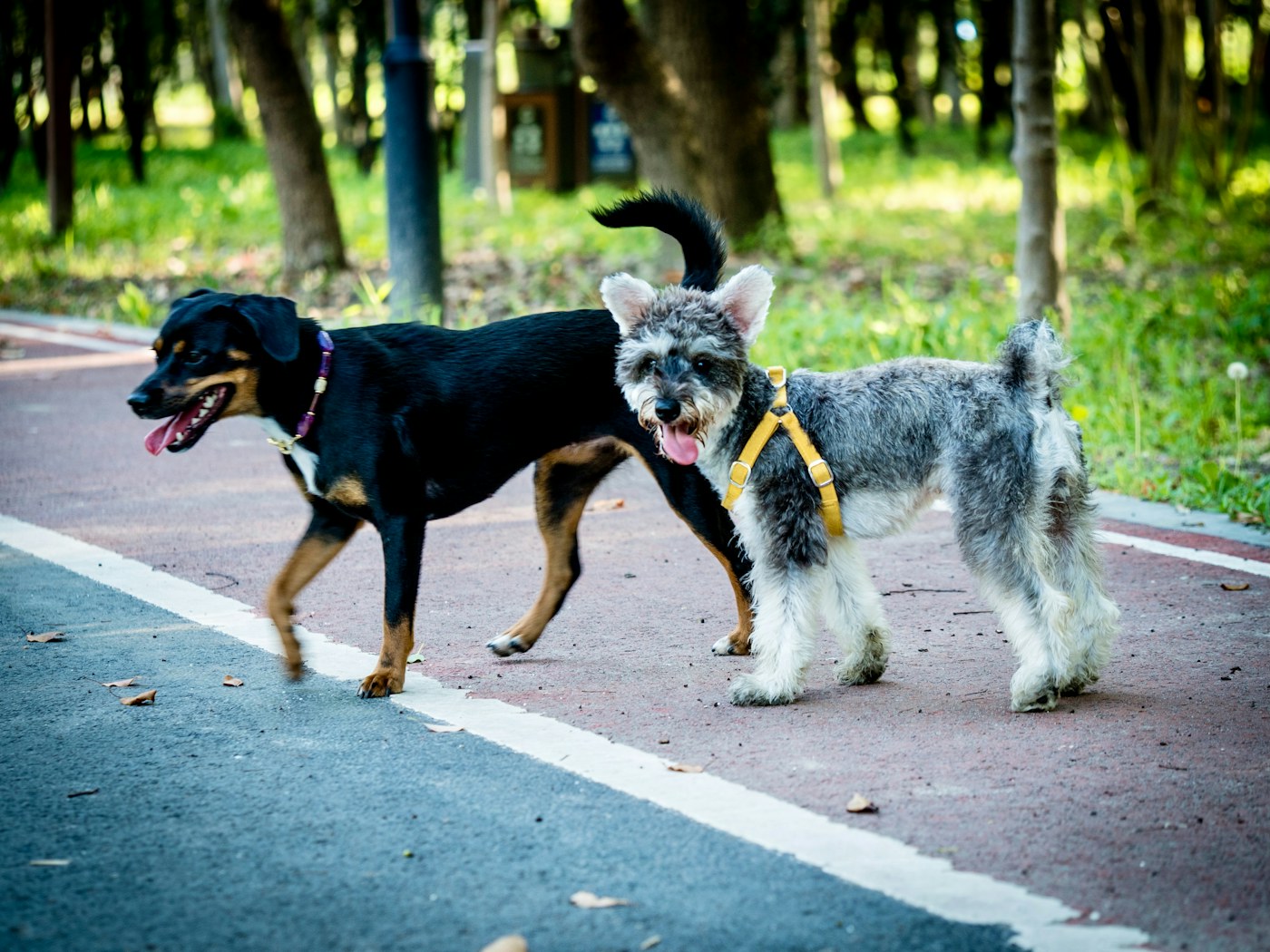
Humane World for Animals recommends neutral territory, separate handlers, and beginning at a distance. There is no single correct distance for every pair: choose enough space that both dogs can remain manageable.
- Choose a quiet, suitable place. Avoid a crowded dog park or a narrow path that forces the dogs together.
- Give each dog a handler. Begin walking separately in the same general direction, with room between you.
- Observe before moving closer. Reward comfortable behavior individually. Keep food with each handler rather than scattering it between the dogs.
- Reduce distance only when both are ready. If either becomes tense, fixated, or difficult to guide away, increase space and pause.
- Keep any greeting brief. When a greeting is appropriate, allow a short investigation, then move on instead of holding the dogs face-to-face.
Dogs Trust advises moving away if either dog becomes uncomfortable and allowing introductions to unfold across separate short meetings when needed. Walking near each other without interacting may be the useful first outcome. You do not need to complete every stage on arrival day.
Watch the whole interaction, not just a wagging tail
Read posture, movement, distance-seeking, and the situation together. A single signal is not a complete assessment. Humane World for Animals advises watching for warning signs and interrupting interactions before tension escalates.
The following is a practical pause-and-review table, not a diagnostic tool:
| What happens | Next step | What to avoid |
|---|---|---|
| A dog turns away or tries to create distance | Allow space and pause contact. | Bringing them back to finish the greeting. |
| One repeatedly follows while the other cannot rest | End the interaction and provide separate breaks. | Waiting for the pursued dog to handle it alone. |
| Staring, stiffness, or escalating excitement makes handling difficult | Move apart and reassess with qualified support. | Moving closer to see what will happen. |
| Growling, snapping, lunging, or an injury occurs | Prevent further contact; obtain professional advice and veterinary care for injuries. | Punishing warnings or immediately trying again. |
Do not reach between fighting dogs or grab near their mouths. Plan separation before any meeting; a developing conflict is not the time to invent one. When safe management is uncertain, stop and get hands-on professional guidance.
Bring the plan indoors, not just the dogs
Guide Dogs recommends a spacious area away from valued resting or eating places for home introductions and removing potential sources of competition. Start with an easy part of the house rather than a crowded hallway.
Let the newcomer investigate without the resident dog following them everywhere. Keep shared time manageable and provide regular separate breaks. Feed separately and offer chews or other valued items in separate spaces. Until you are confident about the relationship, separate the dogs whenever direct supervision is unavailable.
Best Friends’ foster-care manual similarly recommends individual introductions, supervised contact, and keeping high-value items in the dogs’ own areas. With more than one resident dog, do not turn the arrival into a group greeting.
For enrichment, choose suitable activities for each dog separately first. Our chewing guide and food-free activity ideas can help with individual routines; food-free does not mean a shared toy cannot become a resource concern.
Introducing a puppy to an adult dog
A puppy’s energy does not make repeated pestering harmless. Dogs Trust notes that puppies need extra supervision because they are still learning social signals. Give the adult dog genuine escape from interaction, and help the puppy disengage rather than expecting the older dog to teach every boundary.
Adapt meeting arrangements to veterinary advice about infection risk and health. Avoid a universal age or vaccination shortcut: the appropriate location depends on the individual puppy and local circumstances.
Humane World for Animals emphasizes patience and preparation when a dog enters a new home. Adjustment can vary widely. A popular calendar rule is not proof that either dog is ready for unrestricted shared time.
A first-days plan you can actually follow
Use this editorial outline to organize care without promising a deadline. For each part of the day, name the handler, the room or route, and the fallback. Write “separate meals, then individual rest” rather than “make them friends today.”
Example: “Morning: each dog has an outing with an adult. Midday: separate resting rooms while work is busy. Evening: a brief shared period only if both dogs have been comfortable; otherwise, individual activities.” Adjust to actual needs and professional advice.
The weekly planner stores one browser-local plan, not separate dog profiles. Use its daily notes for names and arrangements, or keep separate notes elsewhere. Do not assume it tracks which dog has completed a care task.
Common questions
How long does it take dogs to get used to each other?
There is no reliable deadline for every pair. Watch whether both dogs can rest, move away, and use their own resources comfortably. Ask for help before repeated tension becomes the routine.
Should I let them work it out?
No. Manage contact and respond to discomfort early. Do not wait for a fight as evidence that the introduction was too much. A quiet, separated arrangement is preferable to an unsafe shared one.
What if my resident dog growls at the puppy?
Give them space and prevent the puppy from continuing the approach. Do not punish the warning or provoke another one to check it. Repeated concerns, snapping, or any injury call for appropriate professional help.
Can the new dog share toys and beds immediately?
Begin with separate resources. There is no need to test sharing at the first meeting. Introduce changes cautiously only when appropriate for these dogs, and retain individual resting and eating options.
Sources and editorial notes
Best Friends Animal Society, Dogs Trust, Humane World for Animals, and Guide Dogs provide the linked introduction guidance. The household checklist, observation table, and daily outline are organizational examples, not assessments of a particular pair. See our behavior guidance and editorial standards.