All enrichment guides · True to Dogs
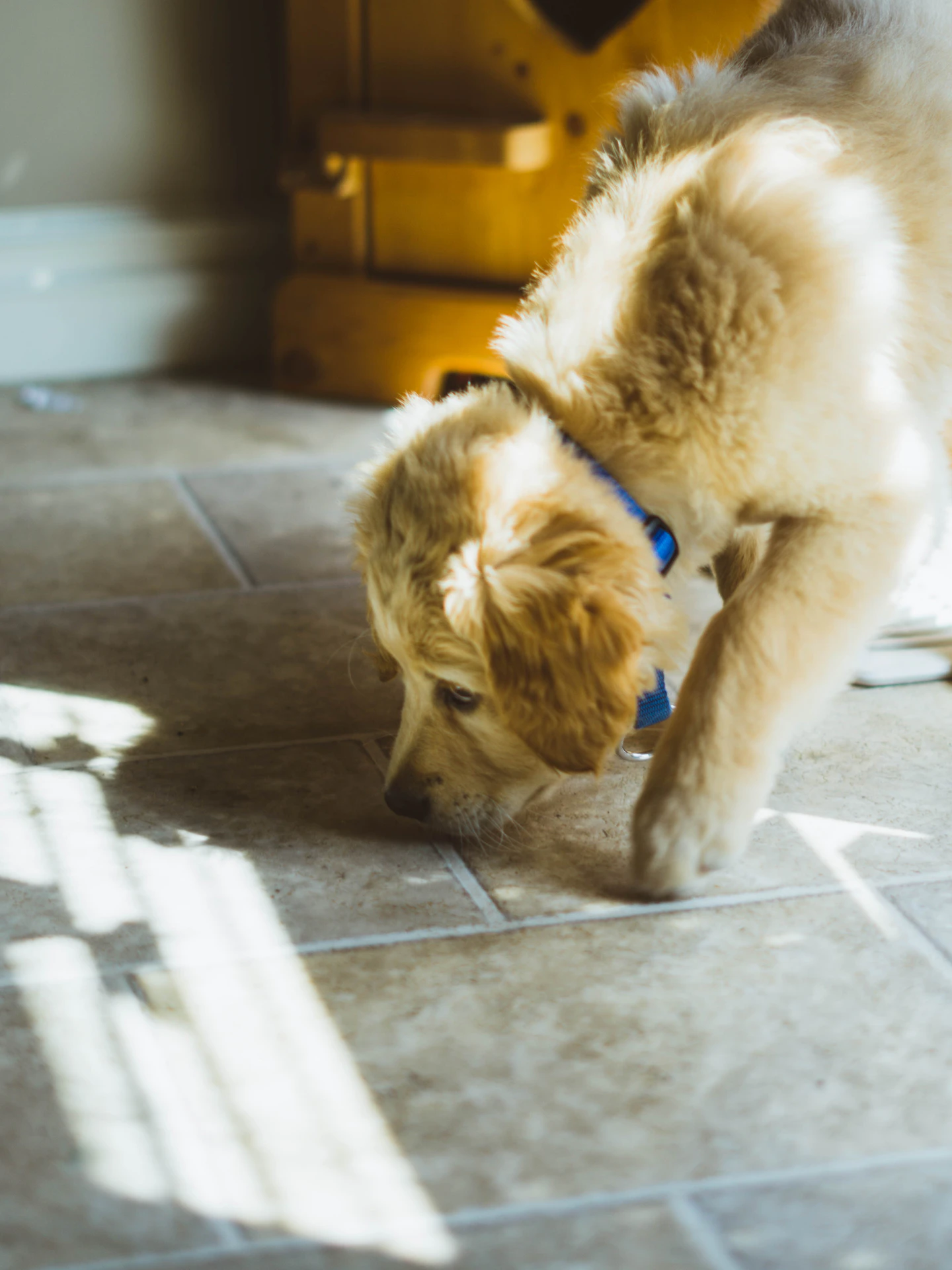
A scent game starts with something your dog wants to find and a search they can understand. Keep the first area small, make the first find obvious, and give your dog time to investigate. You can do that in one room.
Your first search
Use familiar food on a clear floor. Let your dog see where you put the first piece, then give them room to approach. You are introducing the game, not testing their nose.
Choose one of four starting games
Times below are flexible planning estimates for a short session, not tested averages, exercise prescriptions, or a promise of how long your dog will stay interested.
| Game | Space and equipment | First version |
|---|---|---|
| Visible find | Small floor area; usual food | One easy-to-see piece |
| Short trail | A clear path; usual food | A few nearby, visible finds |
| Favorite-toy search | One room; familiar toy | Toy partly or fully visible |
| Open-box search | Small area; suitable box and food | One open, shallow box; no filler |
1. Start with a visible find
Use the find it game to introduce a consistent invitation to search. A visible first find keeps the task clear. On a later turn, move the food a little farther away while keeping it easy to reach. Avoid cracks, furniture gaps, or places your dog would need to climb into.
2. Lay a short trail
Choose a route across a clear, nonslip section of the room. Set out a few pieces close enough that the next find is easy to notice. Invite your dog to the start and follow quietly without pointing to every piece. Finish at an obvious final find, then check for leftovers before reopening the area to other pets.
For your next round, change the route rather than adding more food. Keep the same small portion you planned to use. If your dog skips pieces or seems lost, shorten the trail and make it more visible. There is no need to cover the entire home.
3. Search for a favorite toy
This option suits dogs motivated by familiar play. Show the toy, place it at floor level in an obvious location, and invite your dog over. When they find it, share a short game they enjoy. On another turn, leave part of it showing near a different piece of furniture. Avoid hiding it under unstable objects or in a place where it can get stuck.
4. Investigate an open box
Only use cardboard with a dog who does not chew or eat it. Remove packaging hazards and start with one shallow, open box containing visible food. The American Kennel Club describes box searches as a scent-game format; one open box is a deliberately modest starting point. You can choose the floor instead whenever the box adds worry or chewing.
Adjust the search, not the pressure
- Change only one feature: distance, visibility, or location.
- Use accessible floor-level finds; do not require jumping or squeezing into spaces.
- If your dog struggles, reveal the find or shorten the search.
- Count the pieces before and after so you know when the search is over.
- Finish with a consistent “all done,” collect materials, and let your dog move on.
These are casual searches using food or a familiar toy. They do not require essential oils, scented swabs, or a competition scent kit. If you later want to pursue formal scent work, learn the sport’s handling and training procedures with an appropriate instructor.
Turn one good search into a repeatable activity
In the finder, look for “The little scatter search,” “Follow that little trail,” or “Where’s your favorite?” Save the one that fits. Record the search area and what you changed, rather than trying to measure a universal difficulty level. “Three visible finds by the mat” is an excellent note.
Follow your dog’s lead. Supervise these games, allow your dog to leave, and finish if they seem uncomfortable or frustrated. Food comes from their usual daily allowance. Choose materials for your individual dog; household objects are not chew toys.
Make it fit your day
Choose one activity that fits today, then give it a place in your week. Open the activity finder or open your weekly planner. The planner saves in this browser. Use its daily notes for variations or an activity that is not in the dropdown.
Keep exploring
Sources and editorial notes
This guide is an editorial starting point for everyday play. The organizations below provide background on enrichment or the activity discussed; they have not reviewed or endorsed this page. Adapt every game to your dog.
Published October 4, 2026. Written for busy owners and small homes.