Training & behavior guides · Everyday greetings
To reduce jumping during friendly greetings, prevent overwhelming encounters and reward an easy alternative before your dog jumps. Keeping four paws on the floor is enough; a perfect sit is not required. Practice with a willing adult when things are quiet, not for the first time while a delivery driver waits at the door.
This approach is for a dog who is comfortable with the person and excited to greet them. If jumping comes with fear, lunging, grabbing, or threats, prioritize distance and professional guidance rather than trying to push through a greeting exercise.
Work out the context before choosing the response
Dogs Trust explains that jumping can be associated with excitement, attention, anxiety, frustration, or discomfort. The movement alone does not tell you what your dog feels or why it happens.
Write down who was there, how close they were, what happened before the jump, and what followed it. “Jumped when my brother opened the door and reached forward” gives you more to work with than “always naughty.” Do not recreate a risky incident just to collect observations.
A new behavior change or apparent pain deserves veterinary attention. The Merck Veterinary Manual discusses medical contributors to behavior problems. Training is not a way to rule those out.
If the arrival also involves urination, read why a dog may pee during homecomings. That guide covers what to record and when a veterinary conversation belongs alongside changes to the greeting setup.
Make arrivals manageable before adding a lesson
Dogs Trust recommends using appropriate separation from visitors, keeping dogs on a leash when needed, and allowing them to move away rather than forcing contact. A comfortable room or suitable barrier can make a greeting optional while guests settle.
Plan before the door opens. Choose where the dog will be, who is responsible for them, and whether a greeting is appropriate at all. A separation setup must suit your dog; a barrier that causes escalating distress needs a different plan.
A visitor message you can use: “Please come in without reaching toward the dog. We will let you know whether a greeting works today. When we practice, please keep it quiet and pause if the dog starts jumping.” This is our suggested household script, not a requirement that visitors become trainers.
Keep children and people at risk of being knocked over out of practice sessions. For a real arrival that needs your full attention, choose management rather than an improvised training test. No greeting is a perfectly acceptable outcome.
Practice a short, predictable greeting
Battersea’s greeting guidance uses a helper, rewards for the desired behavior, and brief interactions. Make the starting version easier than a normal visit.
- Start away from the front door. Choose a quiet space and an adult helper your dog is already comfortable around.
- Pick the alternative. Use four paws on the floor, or a comfortable sit the dog already knows.
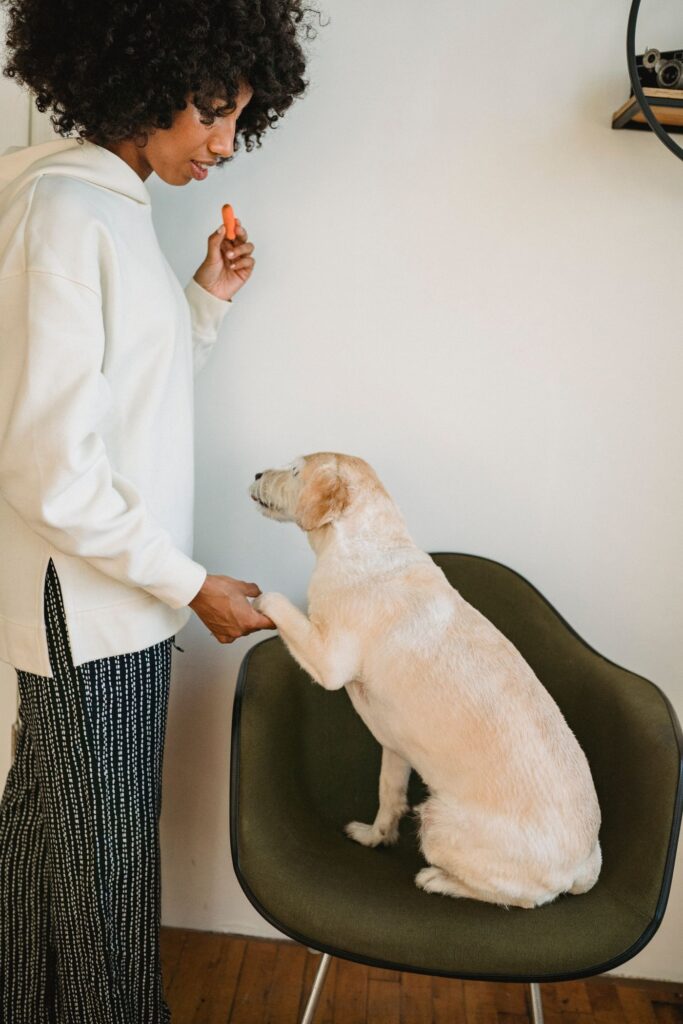
- Have the helper approach only a little. Reward the alternative while your dog can still respond. Use an appropriate loose leash where needed, without pulling the dog into position.
- Add a brief hello. When suitable, invite a calm interaction and then have the helper move away again.
- Reset before excitement builds. Give your dog a break. Short successful approaches are more useful than pushing through an increasingly difficult encounter.
If you need to teach a sit first, use our basic-cues guide. Do not demand a newly learned behavior in the hardest setting. PDSA recommends clear cues, prompt rewards, and consistent practice—not a stream of repeated instructions.
What to do when your dog jumps anyway
Stay calm and stop escalating the interaction. If it is safe, briefly pause attention; otherwise, the person should move out of reach and the session should end. Reward a manageable alternative at the easier starting point on the next attempt.
Dogs Trust specifically advises against pushing a dog down, adding leash tension to get them off, or insisting that a worried dog greet someone. “Ignore jumping” is not permission to remain in a situation where someone is being scratched, frightened, or knocked over.
Do not knee the dog, shout, or use a shock device. The American Veterinary Society of Animal Behavior’s humane-training position supports reward-based methods and advises against aversive techniques. When you need a stronger response, make the safety arrangement stronger rather than the punishment.
Change one part of the setup
Use this editorial planning table after a session. It helps you choose a simpler next attempt; it does not diagnose the reason for jumping.
| What happened | One change to consider | What to record next time |
|---|---|---|
| Quiet practice worked, but the doorbell changed everything | Return to practice without the bell before adding that part. | The exact point when responding became harder. |
| The helper approached too quickly | Start farther away and make the approach smaller. | How close the helper was during an easier moment. |
| Several people tried to greet at once | Use one familiar adult in a less busy room. | Whether the dog could remain comfortable with that person. |
| The dog jumped when hands reached toward them | Remove the touching stage and seek advice if contact appears uncomfortable. | What happened before contact, without testing it again. |
| You could not manage guests and the dog together | Choose a separate care arrangement for actual visits. | Who will handle each job next time. |
A helpful note in the weekly planner might read: “One adult helper after the morning routine; quiet room; reward four paws; no doorbell today.” The planner is a reminder, not a behavior scorecard.
Use the skill beyond the practice room
When the familiar version is going well, introduce a small change rather than the busiest possible encounter. Battersea’s training introduction explains building positive associations and teaching an alternative behavior that can earn a reward. Apply that principle to a new location or helper without assuming the old level of difficulty will transfer immediately.
On walks, leave room to pass people without meeting them. At home, keep the arrival arrangement available even after practice improves. Your dog’s success with a familiar adult does not oblige them to greet every stranger.
For the rest of the day, use manageable shared activities and leave room for rest. Our settling guide and short-practice ideas can support your routine, but neither is an instant fix for every jumping problem.
Common questions
Why does my dog jump only on certain people?
Compare what is different: the person’s approach, movements, voice, and previous interactions. Those are useful observations, not proof of a single cause. Keep practice with people your dog is comfortable around.
Should I make my dog sit every time someone comes in?
Only use a sit that is comfortable and already realistic in that setting. Four paws on the floor or choosing not to greet may be more manageable. Do not rely on a cue as the only protection for visitors.
Can I reward with attention instead of food?
Attention can be rewarding when the dog actually enjoys that interaction. Battersea advises finding what motivates the individual dog. Do not assume petting is wanted; allow the dog to decline contact.
How long does it take to stop jumping?
There is no fixed timetable here. Review progress in similar circumstances, and get qualified help when difficulty persists or safety is uncertain. Fewer incidents because you managed arrivals well is useful progress, even before a new greeting skill is reliable.
Sources and editorial notes
Dogs Trust, Battersea, PDSA, AVSAB, and Merck provide the linked behavior and training background. The visitor script, troubleshooting table, and practice note are True to Dogs planning examples. This guide is not an individual treatment plan. See our editorial standards.
Keep track of the next training step
Turn the teaching step into a simple dog training plan and use the practice schedule to keep sessions manageable. Record the skill, setting, reward, what worked, and what to make easier in the free Dog Training Planner & Progress Tracker. It saves locally in your browser and includes printable logs and backups.