All enrichment guides · True to Dogs
For a puppy, an ordinary object or a tiny new task may already be interesting. Begin with a clear invitation and an easy outcome. You do not need to keep making the challenge harder to give your puppy something worthwhile to explore.
Start small
Choose one activity, in one familiar area, with you close by. Offer a few easy turns and then a chance to rest. Use your puppy’s response—not the number of items on a list—to decide whether to continue.
Five uncomplicated first activities
1. Find one visible food piece
Use a small piece of the puppy’s familiar food on a clean, clear floor. Let them see it being placed. Start with the first step of find it, without hiding food or asking for a long stay. End after a few comfortable turns.
2. Choose between two familiar toys
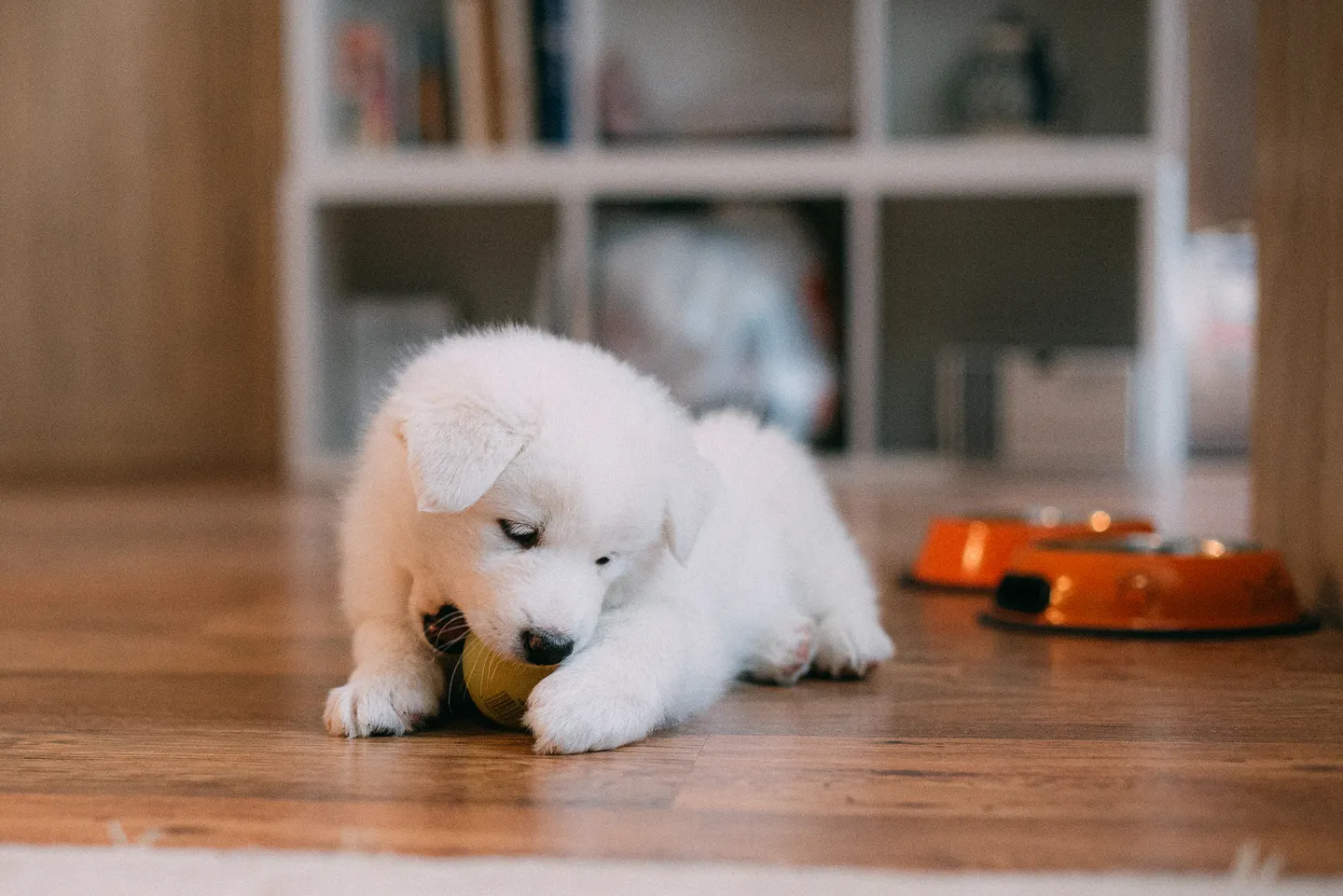
Offer two appropriate, intact puppy toys and watch which one attracts interest. Share a little play with that toy. Keep the interaction gentle and leave plenty of room to disengage. Choosing neither is a valid answer.
3. Try a voluntary nose touch
Offer a relaxed hand at a comfortable height and reward a voluntary nose touch. A few turns are enough for an introduction; see the brain-games guide for the basic pattern. Stop if the puppy turns away or becomes frustrated.
4. Search beside you
Place a familiar toy close by in full view. Invite your puppy to investigate, then share a brief game if they want to. This lets the puppy learn the search-and-play pattern without needing to cope with you disappearing behind a door.
5. Enjoy a quiet moment
Sit near your puppy while they decide whether to approach. Offer gentle attention if they seek it, and pause to see whether they want more. If they settle or move away, let that be the end of the activity.
Be selective with materials
Puppies often investigate with their mouths. Avoid household objects that can be torn into pieces or swallowed, and supervise toys as well as homemade setups. A towel or cardboard game is not a good default for a puppy who chews those materials; the floor-based alternatives are simpler choices.
Choose rewards that suit the puppy’s current food plan. If they have dietary or health restrictions, ask their veterinarian what is suitable. Do not introduce lots of novel ingredients simply to make a game more exciting.
Fit enrichment around the puppy’s day
Use a flexible sequence: meet immediate needs, offer one brief interaction if the puppy is interested, and provide a quiet chance to rest. Puppies need rest as well as enrichment; Dogs Trust explicitly includes that balance in its guidance.
Avoid waking a resting puppy to complete an activity plan. If an energetic period becomes increasingly frantic, pause rather than adding more tasks. A planner should make care easier, not turn every waking moment into a lesson.
Keep simple notes
| Note this | Why it helps next time |
|---|---|
| The exact easy version | Everyone can start at a familiar point. |
| The toy or reward offered | You can identify what was interesting that day. |
| Whether the puppy chose another turn | You have a useful cue for session length. |
| Any chewing of the equipment | You can choose a different material. |
What this activity list does not cover
These are everyday play ideas. They are not a vaccination schedule, an exercise prescription, or a complete socialization plan. Get individualized veterinary guidance for health questions and qualified reward-based training support for behavior concerns. A game should not require you to force a worried puppy toward something.
In the weekly planner, repeat the same easy favorite when it fits and leave the other days flexible. The finder is not age-specific, so review the materials and instructions yourself before choosing a card for a puppy.
Follow your dog’s lead. Supervise these games, allow your dog to leave, and finish if they seem uncomfortable or frustrated. Food comes from their usual daily allowance. Choose materials for your individual dog; household objects are not chew toys.
Make it fit your day
Choose one activity that fits today, then give it a place in your week. Open the activity finder or open your weekly planner. The planner saves in this browser. Use its daily notes for variations or an activity that is not in the dropdown.
Keep exploring
Sources and editorial notes
This guide is an editorial starting point for everyday play. The organizations below provide background on enrichment or the activity discussed; they have not reviewed or endorsed this page. Adapt every game to your dog.
Published October 4, 2026. Written for busy owners and small homes.