Training & behavior guides · Puppy foundations
Start teaching puppy commands with one easy behavior, a clear reward, and a quiet setting. Sit, down, come, stay, leave it, and drop are useful everyday skills. Your puppy does not need to learn all six at once, and knowing a cue in the living room does not mean they can use it around every distraction.
We use “cue” for the word or gesture that tells your dog which behavior you are asking for. The aim is clear communication, not making a puppy comply through fear. These foundations can also help an adult dog learning the same skills for the first time.
Prepare the practice, not just the treats
Blue Cross recommends short sessions, around two to five minutes, with few distractions. Finish sooner if your puppy needs a break. Choose an enclosed, comfortable space with a nonslip surface, and meet their immediate needs before practicing.
Have small, suitable rewards ready and include food rewards in the day’s feeding plan. PDSA’s reward-based guidance emphasizes consistent cues and rewarding the behavior promptly. A quiet “yes” can mark the moment you liked, followed by the reward; it is not a substitute for one.
Agree on words with other adults. For example, use “down” for lying down rather than also meaning “stop jumping.” Pick one skill for the next short session. Our busy-owner training guide helps you find a realistic moment.
First, make checking in worthwhile
In Dogs Trust’s name-training guidance, a useful starting point is rewarding the dog for choosing to look toward you. Once that connection is established, the name can become a request for attention.
Practice when your puppy is awake and comfortable. Notice a voluntary glance, mark it, and reward. As checking in becomes familiar, say their name once and reward a response. If there is no response, make the setting easier instead of repeating the name more loudly. Looking toward you and coming all the way to you are different goals; teach recall separately.
Six cues at a glance
| Cue | What it means | A first practice goal |
|---|---|---|
| Sit | Place the bottom on the floor. | One comfortable sit beside you. |
| Down | Lie down. | A brief down on a comfortable surface. |
| Come | Return to you. | A short approach in an enclosed room. |
| Stay | Keep the chosen position until released. | A tiny pause while you remain nearby. |
| Leave it | Disengage from something not yet taken. | Turn away from a protected practice reward. |
| Drop | Release an item already in the mouth. | Exchange a familiar toy without conflict. |
The order below is a reference, not a six-day schedule. Start with the skill most useful to your household and keep successful repetitions easy.
1. Sit: teach the movement before relying on the word
Dogs Trust’s sit exercise uses a small food lure, then a hand gesture, before adding the spoken cue.
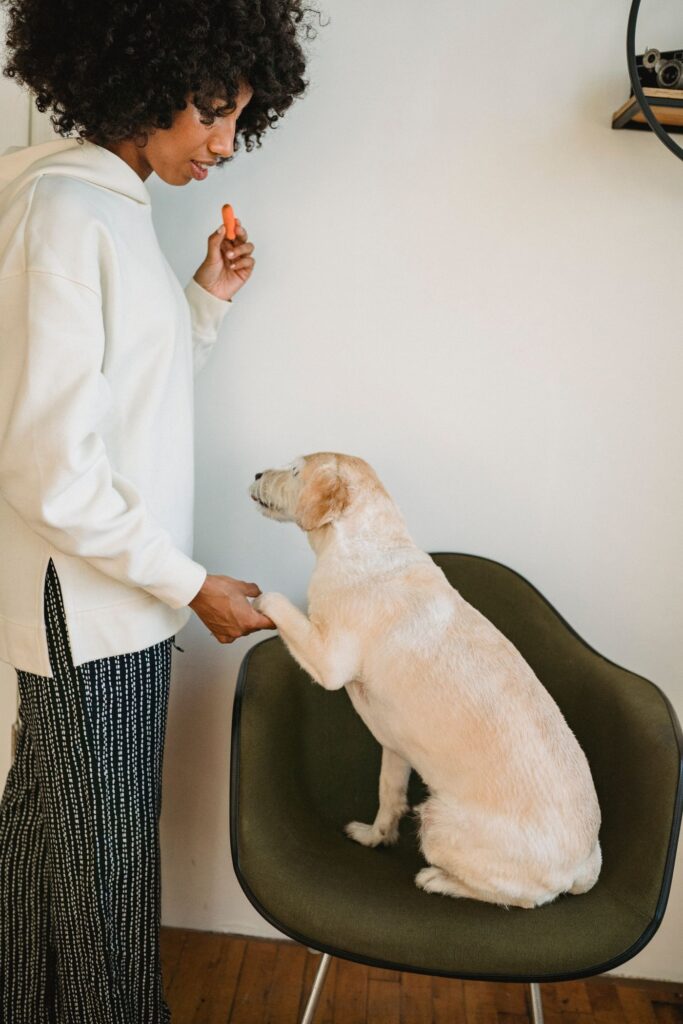
- With your puppy standing comfortably, hold a treat near their nose and move it slowly back over their head.
- When their bottom reaches the floor, mark the movement and give the reward.
- Once the motion is familiar, use the same gesture without food in that hand, then reward from the other hand.
- When that gesture reliably produces the sit, say “sit” before the gesture and reward the result.
If the puppy jumps or backs away, the hand may be too high or moving too quickly. Reset calmly. Never press their bottom into position. A puppy who appears uncomfortable should not be asked to repeat the movement.
2. Down: use a comfortable surface
The RSPCA’s down-training guide begins with the dog sitting and following a treat toward the floor.
- From a comfortable sit, bring the reward from the puppy’s nose toward their chest and down to the floor.
- Mark and reward when they lie down. Keep the first success brief.
- After the motion becomes predictable, introduce “down” as they move into position.
- Practice short, easy repetitions, gradually using a smaller hand gesture.
Do not pull legs forward or hold the puppy down. If they keep standing, simplify the movement or pause. A down is a body position; it does not prove that a dog is relaxed. For settling rather than positioning, use our settle-routine guide.
3. Come: make returning rewarding
The RSPCA recommends building recall from short distances, using rewards the dog enjoys and practicing in safe areas before adding difficulty.
- Start in an enclosed space, close enough that approaching you is easy.
- Move a little away, say the chosen recall cue in a friendly voice, and invite the puppy toward you.
- Reward when they reach you. Keep handling gentle and do not turn their arrival into a reprimand.
- Increase distance gradually. Outside, use an appropriate long training line and a safe environment while the skill is developing.
Do not test a new recall beside traffic, around livestock, or with an unsecured exit. Never call the puppy over to punish them. Include recalls that end in another enjoyable activity, rather than making every return end the fun. Ask your veterinarian about appropriate outdoor locations while vaccinations are being completed.
4. Stay: build time before distance
In the RSPCA’s stay progression, the dog first learns to remain in position for a short pause. Distance is added gradually afterward.
- Begin in a sit or down your puppy can already perform comfortably.
- Use your chosen stay signal and reward a very brief pause while you are still close.
- Reward while the puppy remains in position, then use a consistent release word such as “okay.”
- Lengthen the pause gradually. Add a small step away only when the nearby version is easy.
If the puppy gets up, shorten the next attempt. Do not add distance, duration, and distractions together. A training stay never replaces a closed door, a leash, or adult supervision where safety depends on the puppy remaining still.
5. Leave it: reward disengaging
The RSPCA’s leave exercise starts with a treat protected by a closed hand and rewards the dog for backing away. The cue is introduced after that choice becomes predictable.
- Use an ordinary practice treat, not a dangerous object. Keep it protected in a closed hand.
- Wait for a small movement away. If the puppy becomes frustrated or bites at your hand, stop and ask for help adapting the exercise.
- Reward the disengagement. Progress to adding “leave it” as the puppy backs away.
- For later open-hand practice, reward from your other hand. Protect the practice treat again if the puppy cannot yet leave it.
Keep medicines, dropped food, and other hazards inaccessible regardless of training. “Leave it” is not a safe test to stage with a real toxin or a swallowable object.
6. Drop: practice an easy exchange
Blue Cross recommends teaching an exchange with a reward rather than chasing a puppy who has picked something up. Use a familiar, low-stakes toy for practice.
- While the puppy holds a suitable toy comfortably, offer a food reward they are interested in.
- As they release the toy, say your chosen cue and give the reward.
- Pick up the toy only when it is safely available. When suitable, return it for another brief turn.
- Once releasing is predictable, say the cue just before presenting the exchange, and keep rewarding.
Do not pry the puppy’s mouth open or turn removal into a tugging contest. Freezing, growling, or guarding changes this from an everyday lesson to a concern needing qualified guidance. For objects that may have been swallowed or could cause poisoning or injury, contact your veterinarian promptly.
When the puppy seems to ignore the cue
Use our suggested review order: comfort, clarity, then difficulty. Are their needs met? Have they learned what the word predicts? Is this room busier than the place where they succeeded?
Example note: “Sat with a hand signal in the kitchen; struggled when another person entered. Next time: same quiet kitchen, one handler.” Record this in the weekly planner rather than giving the puppy a pass-or-fail grade.
The American Veterinary Society of Animal Behavior recommends reward-based training and advises against aversive methods. Shouting, leash corrections, or physical force are not a solution to an unclear lesson. Persistent fear, apparent pain, or a sudden change warrants professional advice.
Common questions
What should I teach my puppy first?
Making attention and a short return to you rewarding is a useful beginning. A comfortable sit is another straightforward option. Choose one skill, rather than asking for a chain of unfamiliar commands.
At what age can training begin?
Blue Cross advises that puppies are learning all the time, so gentle, brief reward-based foundations can begin when they come home. Adjust to the individual puppy and allow plenty of sleep and ordinary care.
Should I repeat the command until my puppy responds?
Repeating a word is not the same as teaching its meaning. Use the easiest version the puppy knows, clarify the movement, and reward it. Make the next attempt quieter or simpler.
Can I use these steps with an older dog?
The same beginner skills are useful beyond puppyhood. Adjust movements, rewards, and expectations for health and comfort; do not interpret difficulty sitting or lying down as stubbornness.
Sources and editorial notes
Individual exercises link to Dogs Trust, the RSPCA, and Blue Cross; PDSA and AVSAB support the reward-based framework. The comparison table and practice notes organize that guidance for everyday use. They are not a tested course or a promise of results within a fixed time. Read our editorial standards.
Keep track of the next training step
Choose suitable priorities with the puppy training schedule by age, then pick a small foundation from the training checklist. Record the skill, setting, reward, what worked, and what to make easier in the free Dog Training Planner & Progress Tracker. It saves locally in your browser and includes printable logs and backups.